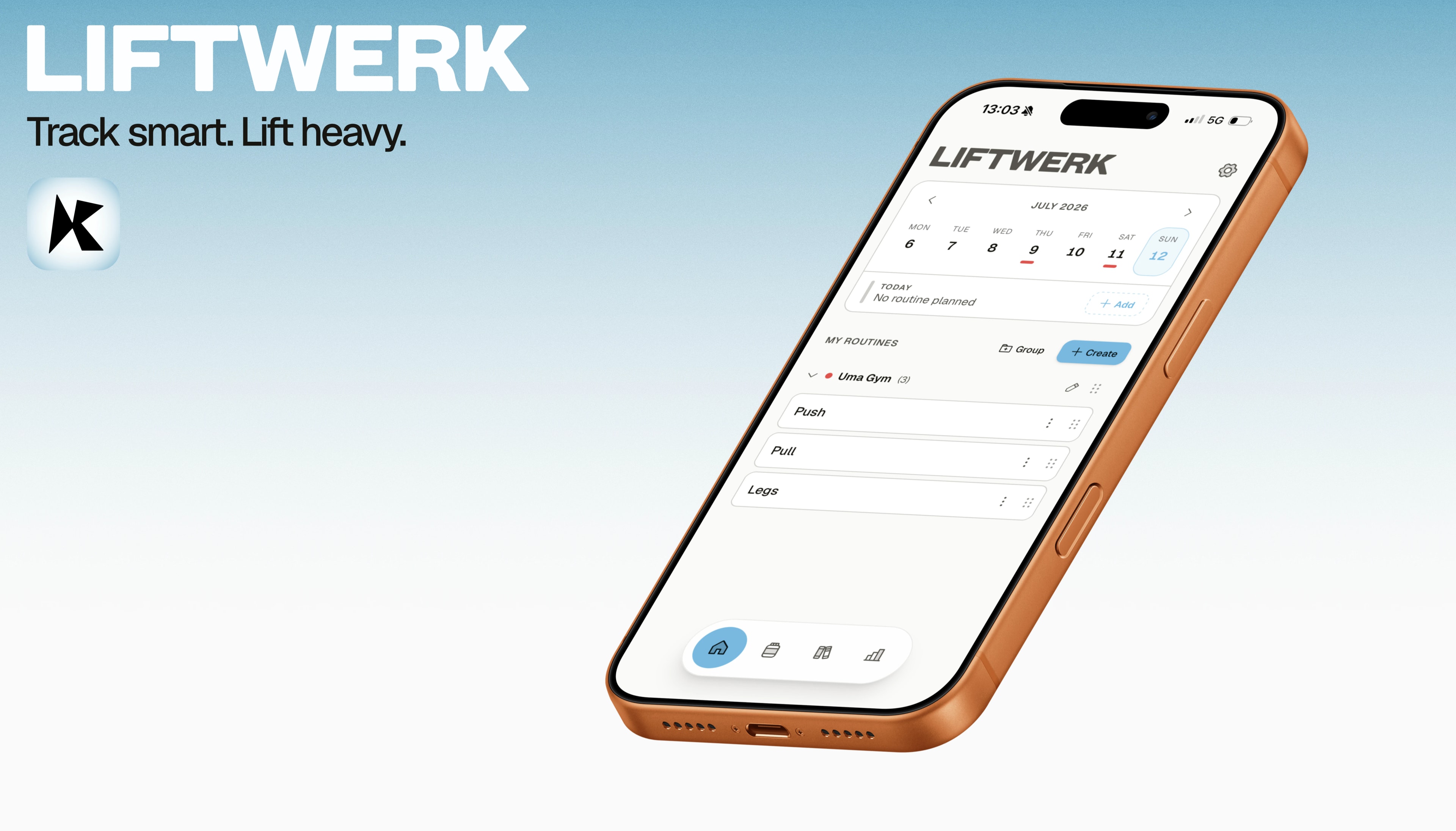
Liftwerk

Minimal strength training tracker for iPhone. Routines, workout history, analytics, and supplement tracking, with no subscription, no ads, no account required, and full data export.
What I've Learned
How to build an app.
Liftwerk taught me everything all at once: Xcode, the full iOS development workflow, how to test properly, how to track down bugs, and how to use AI to read, write, and reason about code. I learned to act as both designer and developer at the same time to build the entire ecosystem from scratch, including the landing page, all the visual assets for the app, the App Store presence, the icons... Now, having gone through the entire process once, I know how to do it again, and do it better. Because going through over 240 builds based on trial and error often teaches you how to optimize your workflow.
I have built the foundation and learned concepts and inner workings of a world that, until now, was unknown to me, one that I used to watch from the sidelines as a designer without ever integrating into it. But now, that has drastically changed.
The Problem
I was always looking for the perfect app to track my gym routines. I used (and paid for) several of them, from the big names to the niche ones, every kind of gym app I could get my hands on. None of them ever truly convinced me. They all had one issue, or several at once: monthly subscriptions, features I didn't need, complex interfaces, onboarding processes that made you want to close the app and never open it again, and the fact that most seemed designed for people who want to share their workouts and build a community around it... I just wanted something simple, unified, and for myself, to track what actually matters to me: improving at the gym with every session. So, when you can't find something that fits your needs, the solution is simple: build it yourself.
The Approach
The approach kept shifting as I built the app; it started out as something much simpler than the final product. It's when you actually start building the system that you see all the possibilities and features you could include. However, I knew one thing for sure: I obviously didn't want to include any of the things that annoyed me about other apps, keeping only the features I found useful. For example, there are no social features, no chats, no profiles, no following other users… the workouts are just for me (though there is a share option, just in case you are working with a trainer). But above all, it's missing something I've seen a lot lately that really bugs me in these kinds of apps: no AI coach, no AI-generated routines. Maybe that drives away someone who is looking for a gym app and expects everything handed to them, or a pre-made routine to follow, but I don't think that's the right approach to make progress. That's exactly what I reflect in Liftwerk, where you need to know your routine (you can even create it based on movement patterns), you know your exercises, and you just want to log what you're going to do every week, without useless features. Just the essentials. I also added things I haven't seen in other apps that I consider genuinely useful, such as supplement tracking, which is closely tied to gym workouts. Or the option to log unilateral exercises, something I haven't seen in many apps, not even the most popular ones.
The Build
At the time of writing these lines, we are coming off the massive AI boom that has globally and permanently changed how things are done. As a designer, I've always had ideas in mind and I've always wanted to create products. The problem? Development. And what does AI do best? Develop. So, from day one, with the invaluable help of my brother, who is a DevOps engineer and developer, I dove right in, paid my first 20 euros for Claude Code, and stepped into the jungle (it's dangerous to go alone, take this!). Within a week, I already had to upgrade my subscription to 90 euros a month. These days, I barely use Claude Code as a primary tool; it has become more of a complementary part of my workflow.
From that moment on, I started experimenting, and one of the first ideas to emerge was Liftwerk. I finally set out to build my gym app: frameworks, Swift, Supabase, Xcode, TestFlight… AI can get you something functional fast, but I didn't want to ship a rough first version just because the tools made that easy. I wanted to build it with care, not rush it out the door. It took me 3 months, and I'll tell you that most of that time was due to my innate perfectionism coming from a design background (can you center a div?). I tried to deeply refine the app's design; I had the structure clear in my head, so I translated it into code and fixed the bugs that popped up along the way, which made me learn even more (the bugs are the friends we made along the way).
Build by build, I created the app I always wanted to have and decided to open it up to others, in case anyone else finds it useful. It's available for a one-time payment, no subscriptions (it would be ironic if I complained about subscriptions just to put a subscription on my own app, right?). The most important part is everything I learned in the process.